.png)
Painting Cathedrals:
The Sacred Work of Making & The Ministry of Art
BY: HANNAH SIMON
Published: 7.20.26
Read time: 14-20min
E
work ever reaches the world.
With this piece, we're continuing our exploration of the creatives whose work leaves a lasting imprint on culture. Through these conversations, we examined not only what's made, but what's asked of the people who make it. Emotionally, spiritually, physically.
In this interview essay, Philadelphia artist Nazeer Sabree reflects on healing, generational memory, stewardship, and the spiritual practice of painting—revealing that some of the most enduring works are built long before the first brush ever touches the canvas.

Often, art is viewed only through the lens of consumption—but what does the artist we devour consume first? What do they witness before we ever witness the work? What do they carry? What do they swallow? What settles into the body before it ever reaches the canvas?
We greedily consume the finished piece, but rarely stop to consider the cost of creation.
Earlier this year, we sat down with Philadelphia artist Nazeer Sabree to begin where many of his works do: the underpainting. What began as an examination of the layered collage work beneath his canvases slowly unfolded into something much greater than process or technique. Like the paintings themselves, the conversation revealed itself layer by layer—moving from composition to memory, from memory to generational trauma, from trauma to faith, and ultimately, to healing.
Along the way, Sabree reveals something quietly extraordinary: before a painting is finished, it has to sing. After beginning each work in prayer, he listens for the moment when the canvas begins to speak back—when the work carries a rhythm that feels truer than his own hands alone. Only then does he know it is complete.
We began with the art, but ended somewhere far deeper—in the vaulted ceilings unique to cathedrals. His paint is testimony. His hands preach. His heart bears witness. The canvas tells the truth.
Pain. Generational trauma. Faith. Philadelphia. Healing.
Nazeer Sabree bears the burden of transforming lived experience into something others can enter. Inside the confines of his studio, he is painting cathedrals—spaces where memory, grief, hope, and grace are given form. What follows is a verbal essay on the cost of becoming a conduit and the sacred responsibility of carrying truth before releasing it into the world.
This is Nazeer Sabree's story, told through his words and recorded by his hands.
What do the collages and the “False Face” series explore?

Manny L. and his Mother (Marilyn) 1998
M: It was the unorthodox style - on both ends. Like wrestling, each artist had their own character, their own vibe, and that made them stand out. I was drawn to the flows and all the little sound effects you could catch tucked into the beats. It was those moments in a song that make you stop and say, ‘Damn, that was crazy’ — the details that make you fall in love with it.
M: I was a kid, so I wasn’t really interested until high school. I always used to make beats, but it started out as me just drumming on desks before I actually learned how to make music. My first real beat was definitely in high school, but knowing me, I probably didn’t like it because it felt hard. Back then it was mostly me just playing around with my friends, rapping and not taking it too seriously. That didn’t really shift until college. I ended up dropping out—I was studying forensic science—and that’s when I started leaning into music full-time.
M: Spaceboy, for sure. Before that, me and my boy Tsan dropped an EP called Farewell, and that really built a lot of momentum for me. I always knew I could do this—I just wasn’t sure how far I wanted to take it.
M: Once I knew I wanted to do music in college, it stopped being just a hobby—but it also wasn’t like, “okay, I need to be the best at this.” It felt more like playing a video game to me. I wanted to get good at it and do well, and that’s what made it fun. To this day, I still see it the same way—I do music for fun, not for the money. It’s never been about that. Honestly, I’ve spent way more investing in my music than I’ve ever made from it. In the beginning, I had to buy software, hardware, plugins—everything just to make beats. I even took piano classes in 2023 so I could understand music better. It was boring, but now I can read music, and that was the whole reason I pushed through it.
I don't think I needed though...I don't believe in music theory or that a certain key makes a hit. All the music I make is in C major. I guess it's my accidental signature.

Featured: Manny L. and Friend
When learning how to produce, did anyone teach you?
M: Nah, I’m a self-taught producer. I don’t believe there’s a right or wrong way to make music—everyone has their own thing that works for them. With synthesizers, I got good because I was messing up, playing them the way they weren’t “supposed” to be played, but sonically it stood out. I like throwing weird sounds and instruments together, colliding them all in one—and that’s not something you can really be taught.
.png)
Featured: Manny L. in Promotional Photoshoot
What was your first time in the studio like?
What are one or two tips you'd give to an aspiring producer or artist to help them along in their journey?
J: Since jobs weren’t happening, I started an agency with two friends. We got clients, made decent money, and even produced a Puma event around the NBA Draft. It was a huge learning experience.
Eventually, my partners got full-time jobs, and misalignment started to show. We ended up dissolving the company, which was hard, but it forced me to get clear about what kind of business I wanted to build and how I wanted to work with people moving forward.
After that period of reflection and uncertainty, you decided to go all in on yourself. What finally gave you the clarity — or courage — to launch your own agency independently, and how did you define what you wanted it to stand for?
Manny L. and his Mother (Marilyn) 1998
Featured: Manny L. and Friend
Featured: Manny L. and Friend
Manny Laurenko’s story is still unfolding, but what’s clear is his foundation: resilience, faith, and a love for creating sound that hits deeper than the surface. From drumming on desks to shaping tracks for some of hip-hop’s biggest names, he’s proof that raw talent paired with persistence can carve its own lane. Independence hasn’t just given him freedom—it’s given him character, vision, and a blueprint that goes beyond music.

The beats are only the starting point for Manny. Here’s the wisdom he leaves behind for every creative chasing their own vision:

efore a moment becomes a headline, it’s a strategy. Public-facing success is designed and constructed by storytellers and architects who understand how to build worlds around talent, brands, and ideas. This interview is part of CGR’s ongoing exploration into the people who move culture without always standing at the center of it. The ones who build worlds around talent, shape narratives before they hit the public eye, and understand that timing, trust, and vision are just as important as visibility.
In this installment, we sit down with a rising force in public relations to trace his journey, unpack his process, and understand how he creates motion — not by chance, but by design.
N: A lot of what appears in my collages speaks directly to Black and brown culture. Some of the references require you to be “in the know,” while others began from a deeply personal place—my adolescence and the world around me from roughly age 12 through 20 or 21, when I returned home after living and studying art in Oakland and San Francisco.
When I came back, especially around the height of the violence in Philadelphia from 2020 through 2022, I was watching people I had gone to school with pass away. Some of those young men had made a real impact on my life. Their influence shaped who I met, how I moved, and the relationships I formed.
The “False Face” series examines the way I masked that pain when I was younger. I was living close to the violence even though I wasn't necessarily a street kid. I came from a family affected by incarceration; my father was largely absent, and the male figures in my life weren't consistently stable. The series became a way for me to ask what masculinity looked like when the examples around me were filtered through violence, grief, and instability.
Gallery work (Like the false face collection) allows me to be more vulnerable than public murals, where I can't be as emotionally transparent because they live in communal space. The murals can speak to communal pain, but the gallery work lets me move more directly into family and generational pain.
That led me into what I call the “TRF 98s,” short for “Transgenerational Rorschach Fragments, 1998.” Those works explore the idea that trauma isn't black and white; it exists on a gray spectrum. Many of the things I've dealt with weren't new in my family. My great-great-grandfather experienced wounds he didn't have the tools to confront, and those wounds disrupted the lives of my grandparents, aunts, and great-uncles. My family ultimately came to Philadelphia after running away from that pain in North Carolina.
When I went to college, I finally had room to breathe, access therapy, and think about what I felt. I was angry with my mother about a lot of things, but through conversations with her in my early twenties, I realized that many of the things I felt about her were the same things she felt about her mother. I began to recognize the patterning of trauma and shared wounds across generations.
J: I don’t remember one specific ad or piece of media, but I do remember always watching things differently. When I watched movies or commercials as a kid, I wasn’t just consuming them — I was thinking, how is this happening?
I was focused on the mechanics of it all: how many people it took to make a single scene work, how lighting or sound shifted the mood, how everything came together. That mindset connects directly back to tech theater — being part of a process where there’s pressure, expectations, and a need to make everything click at the right moment. That curiosity never really left me.
You graduated during COVID. How did you stay motivated and afloat?
efore a moment becomes a headline, it’s a strategy. Public-facing success is designed and constructed by storytellers and architects who understand how to build worlds around talent, brands, and ideas. This interview is part of CGR’s ongoing exploration into the people who move culture without always standing at the center of it. The ones who build worlds around talent, shape narratives before they hit the public eye, and understand that timing, trust, and vision are just as important as visibility.
In this installment, we sit down with a rising force in public relations to trace his journey, unpack his process, and understand how he creates motion — not by chance, but by design.
E
very work of art carries a history. Not every history can be seen. Some are painted boldly across the surface. Others remain beneath it—in memory, in faith, in grief, and in the quiet moments that shape an artist long before the work ever reaches the world.

very work of art carries a history. Not every history can be seen. Some are painted boldly across the surface. Others remain beneath it—in memory, in faith, in grief, and in the quiet moments that shape an artist long before the
Often, art is viewed only through the lens of consumption—but what does the artist we devour consume first? What do they witness before we ever witness the work? What do they carry? What do they swallow? What settles into the body before it ever reaches the canvas?
We greedily consume the finished piece, but rarely stop to consider the cost of creation.
Earlier this year, we sat down with Philadelphia artist Nazeer Sabree to begin where many of his works do: the underpainting. What began as an examination of the layered collage work beneath his canvases slowly unfolded into something much greater than process or technique. Like the paintings themselves, the conversation revealed itself layer by layer—moving from composition to memory, from memory to generational trauma, from trauma to faith, and ultimately, to healing.
We began with the art, but ended somewhere far deeper—in the vaulted ceilings unique to cathedrals. His paint is testimony. His hands preach. His heart bears witness. The canvas tells the truth.
Pain. Generational trauma. Faith. Philadelphia. Healing.
Nazeer Sabree bears the burden of transforming lived experience into something others can enter. Inside the confines of his studio, he is painting cathedrals—spaces where memory, grief, hope, and grace are given form. What follows is a verbal essay on the cost of becoming a conduit and the sacred responsibility of carrying truth before releasing it into the world.
This is Nazeer Sabree's story, told through his words and recorded by his hands.
Nazeer Sabree


Each body of work became one part of a larger story: the community, my family, and eventually myself. The most recent body of work is the most vulnerable. It pivots aesthetically from what I'm known for and focuses on self-healing, beginning with the death of my grandfather. That was the first domino effect of pain in my life. After he passed, everything in my family seemed to fall apart. So, my parents’ got divorced, I knew what it felt like to live in a two-parent home and then to lose that dynamic...I grieved many of the things and people I had experienced. I was afarid to talk about that pain, maily because of people pleasing. As a kid, I thought that if i made everything feel like it was ok, it would bring everything back togther. So this work examines that and the early days of my childhood.
That work also reflects my spiritual upbringing. I was born Muslim but raised largely Christian. My family includes both Muslims and Christians, and my mother moved between those faith traditions. The Bible stories, gospel music, prophecy, and images from films like The Passion of the Christ stayed with me even before I understood them. I was once told I would become a preacher, and now I see the work as an unexpected form of preaching.
My latest body of work lets the child version of me heal with the guidance of the adult version of me. Across all three bodies of work, I am talking about the community, my family, and myself in order to bring the story full circle and trace the process of healing.
What parts of the hard stories feel easiest for you to translate into art, and what parts are you still resisting touching physically?
N: I don't think any of it's easy at this point. What I have learned is what to keep for myself and what to give to the audience, so that I am not exploiting every part of myself or giving everything away.
Because art is so vulnerable, how did you learn what to keep for yourself?
N: Through journaling, but also through my interactions within the art industry. Art is an industry like any other, and there are people who will try to take advantage of your wounds, your openness, or your desire to be seen. If you don't have awareness or trusted people around you, you can end up in uncomfortable situations.
God placed people around me who've helped protect me, but I also had to learn through experience. There were moments when people knew what I did before they knew me. They would approach me while I was eating, call to me from cars, or stop me in public. That can be frightening because you do not know who is watching you or what they think they know about you.
I love people, but some people are so hungry that they will try to devour you by any means. Without boundaries, you can be taken farther than you intended to go. I've been in interviews where I could tell the person was trying to force a particular clip or narrative. Early on, I assumed there were certain things an interviewer simply would not do, but I learned that some people come with a frame already prepared and want to fit you into it.
That experience taught me to be more careful about what I disclose, what I allow people to define, and how much access I give to my interior life.
Your work examines Black perception and trauma, and your role can expose you to other people’s emotions and projections. How are you protecting yourself from being retraumatized as you are observed?
N: Firstly, I try not to take on what is not mine. I also believe God has placed certain protections around me. Sometimes people don't overstep because of my demeanor, the authority I carry, or the people I'm with. Authority is something you can't fake; people can feel when it is present.
Practically, I journal, write, pray, talk through my emotions, and stay close to people I trust. They know me well enough to ask where a thought came from or to tell me when something doesn't sound like me. A feeling can attach itself to you even when it didn't originate with you, so trusted people help me backtrack and identify what I picked up from an interaction.
I also had to confront the ways I once used public attention to feed my ego. When I was hurting, praise and compliments felt like they could fill something in me. Eventually, that stopped feeding me.
People now call me humble, but I do not necessarily think of it that way. I'm simply not campaigning to become anyone’s idol. I notice how differently people react when they hear a list of my accolades vs me introducing myself as me, Nazeer; and that makes me question where they believe my value lies. If the accomplishments stopped, would I still be valuable to them?
Is the discomfort partly because you are self-contained—you pour through your art, but you don't want people extracting parts of you that you did not willingly give them?
N: Yes, in a way. I love people, but I also understand that people can be hungry. They can try to consume you, especially when they feel entitled to your story, your pain, or your success. The issue isn't the connection itself; it is the lack of boundaries and the way people sometimes decide they know you because they know your work.
That's also why media can be uncomfortable. An interviewer may be searching for a predetermined story rather than listening to who you actually are. I've learned that being open doesn't mean giving everyone unrestricted access.
I'm trying to focus instead on being present with what God has given me stewardship over. That helps me leave attention, praise, and projection where they belong instead of carrying them home.
There have also been moments when I looked at myself and wondered when I agreed to become this version of myself. Not because I did not love who I had become, but because the transformation felt dramatic. Those moments made me slow down and check what I was taking with me after events, interviews, and public interactions. I am sensitive to energy, and sometimes I have had to leave the studio or sit quietly until I felt that I had released what was not mine.

Going back to the beginning a bit, when did art itself call to you? Was it when you were a little boy, or when you were older?
N: I don't think it truly called to me until I was older. As a child, I knew I wanted to create, but I initially made art because of my father. I idolized him and believed that if he saw me draw something impressive, it would influence how he was involved in my life.
He was an illustrator, and he bonded with his mother through comic books. My grandmother had mental health issues, and he didn't know his father, so comic books became one of the ways they connected. He went to Fleisher on Saturdays and developed a real gift for drawing what he saw.
Watching him and inheriting some of the things he left behind made me want to prove my value by being interested in the things he liked. My own interests were more naturally music, games, and superheroes. I learned to draw, but I wasn't even the strongest artist among my siblings when we were young; my sister was better.
Art became more significant for me around 18 or 19, when I went to college. Before then, I knew it was something I could do, something that brought attention, money, and connection, but I did not respect it as a path.
At different points, painting and drawing helped me make money, manage depression, earn scholarships, enter programs, and open academic doors. Even then, I did not fully understand its value. That changed when I met a professor named Randy Chavez. The way he spoke about art made things click for me, and I began to understand that I was no longer simply chasing my father or trying to earn someone’s approval. I could use the work to confront the pain I had experienced.
Part of my earlier lack of respect also came from not seeing much value attached to art in my community. As an insecure young person, I did not see it producing validation, money, desirability, or models of Black success. Instagram changed that somewhat. I began seeing Black artists who looked like me, listened to hip-hop, cared about fashion, and illustrated contemporary culture. I did not learn about the masters or contemporary fine artists until later. I had no formal fine-art training and attended a high school focused more on architecture and design, so I learned aesthetics before I learned the emotional language of art.
Your work is gorgeous, and it feels that way because some of it feels intentionally unresolved or withheld. In the yellow painting, for example, with the arms around the central figure, what were you trying to evoke or communicate to the viewer?
N: There's a two-ness to it. In my art, I'm self-serving in the sense that I focus on myself first. That particular painting tries to articulate what it felt like when I didn't understand how to see women—even while being physically close to them, having relationships, and participating in intimacy.
It's about being close but not present, vulnerable, or emotionally unavailable. The figure is being held, but it's almost the ghost of being held because he can't really see the person caring for him.
I was trying to show how pain and trauma can erase someone who genuinely cares about you. You may not intend to hurt them, but you can be blinded by pain, lust, rage, or the warfare in your mind. Someone can be holding you, and you still cannot acknowledge or feel them. The painting also asks the viewer to consider what it is like to be the person who is present but unseen.
N: I don't think I consciously calculate the balance in the studio. I know something is right when I can hear it. When a painting starts to sound like a song, I know I'm close. At that point, I either need to stop or have someone who cares about me pull me away, because we know artists can always keep working.
Once I hear the work and it sounds like the feeling I was trying to express, that internal sound becomes the thing that creates the visual balance.
How do you balance clarity with mystery in your work?
Can you describe what it means to ‘hear’ a painting? Is the art singing to you, or is it the Holy Spirit?
N: I think it is both.
The portrait of my grandfather that I produced was one of the strangest and most powerful experiences I've had in the studio. It took the longest time I've ever spent on a painting. I listened to songs we used to hear together, and I cried in a way I had never cried for him—not even when I first learned he had passed on.
While painting, I could almost feel his flesh, the thickness of the tissue, and the structure of his anatomy. After that experience, I began to feel similar things in other paintings. When painting my partner, I could feel her lips and understand why I admired the shape of her nose. That level of connection can be frightening because it feels like alchemy.
There were also moments when I would look over at the portrait of my grandfather while laughing in the studio with my best friend and feel as if the painting were smiling with us.
I saw the weight of the work differently when my mother came to the studio. I was focused on craftsmanship, but she wasn't simply seeing a painting—she was seeing her father and remembering the day we laid him to rest. I had to recognize that inviting her into that space carried deep emotional consequences.
Another nonfigurative painting of a cross explores lust, idolatry, and the things I once mistook for life. To me, you can hear the rhythm of Pusha T’s “Crutches, Crosses, Caskets” in that work. The same musical feeling that lived in me when I danced near the stereo at my grandparents’ house or rapped with friends in high school has been transmuted into painting. The work has a soundtrack. When I can't hear it, I know I'm not finished.
I believe that spiritual dimension arrives more honestly when I don't force it. Sometimes I begin a studio session with prayer and ask God to use my hands as He uses His to create, and to help me articulate what only He knows is in my heart.
There are times when I look at something I painted and barely remember making it. That can trigger impostor syndrome, but I try to understand it differently: God gave me the gift and placed me in stewardship over it. My responsibility is to be fruitful and keep working.
It feels like dancing with the work. I don't mean to romanticize the practice, but something spiritual happens in the room that is larger than ego and larger than any narrative a viewer tries to place on the painting.
Because you're turning pain into something meaningful and acting as a vessel for more than your own story, how do you keep from being consumed by the work or falling too deeply inward?
BY: HANNAH SIMON
Published: 7.20.26
N: I don't think I've mastered that, and I don't want to pretend that I have. Each body of work takes me somewhere different.
God has placed people in my life who help pull me away when I go too deep. I can become so involved that I don't realize how far inward I've gone, but the people close to me can see it.
During my first solo show, I was producing a lot of work within a defined style, but I was still protecting parts of myself. The later “Pursuit of Healing” show was different. My curator and manager, Ginger, later told me that she would leave the studio and cry after listening to me describe what I had experienced. I could talk very normally about watching videos of people I knew dying, abandonment, violence, and the way those experiences shaped my behavior because I had become detached from the fact that I had actually lived them.
The people who care about me could connect the dots between those stories and the way I moved through the world. They could see the impact before I could.
I also realized how deeply certain expectations had been normalized for me. At one point, I believed going to jail was almost a prerequisite of life because so many men around me had gone. I had to learn that this was not inevitable.
After my first solo show ended, I crashed. I found myself alone on the studio floor crying, frightened by the attention, the money, and the fact that parts of my internal life were falling apart. I had stopped journaling, walking, and praying because I was so consumed by the work. Once the show ended, I felt the aftermath.
With the next body of work, I tried to create more balance: work in the studio, prepare at home, spend time with family. But I learned that every body of work has its own energy, like an album. You cannot recreate the exact emotional temperature of a previous project.
The latest work involved more spiritual practice than anything I had made before—prayer, worship, learning about God’s love, crying while painting, and sometimes feeling my spirit resist a direction and tell me to step away.

Afterward, I felt confused because I expected the outcome to appear materially, but the real outcome was spiritual. The work became a love letter to my relationship with God. I made it regardless of whether people understood it, whether it matched the aesthetic people expected from me, or whether it sold.
I eventually understood that the greatest transaction was not financial. It was becoming closer to God than I had ever been. The work planted seeds in other people. People reached out to say they had never seen someone speak so openly about faith through art, that they had started reading bell hooks, journaling, or reconsidering their own healing.
Still, I would be lying if I said I can always stop myself from being consumed. When I'm in it, I'm in it—sleeping in the studio, working on four hours of sleep, forgetting food. The way I come out is through God and through people who love me: my best friend asking me to get food, my partner telling me a thought does not sound like me, my curator checking in, or my mother coaching me through what she sees God changing in my life. I have not yet learned how to pull myself out entirely on my own.
Read time: 14-20min
What phrase, word, or piece of guidance has helped you become who you are—and what would you give to the next generation of creatives?
N: The first word that comes to mind is courage: have courage.
People meet the prepared version of me and see the finished work, but they do not see me in the house or studio wrestling with fear. A lot of the time, I am scared because I am about to address something sensitive.
Doing something while you are afraid is courage.
It is not necessarily humility, boldness, or an enormous sense of confidence. It is courage. I had to establish it early in life, and pursuing any dream requires it.
When you are not afraid to feel, to be disliked, or to speak up, those are all expressions of courage. So the thing I would give the next generation is simple: have courage and do it afraid.
Courage.
The final stop on this part of our journey with Nazeer—and, we hope, the next step on yours.
This conversation asks us to look beyond the finished work and toward the life beneath it. To consider how transparency, conviction, faith, and the world around us become part of everything we create. Because art has never been merely decoration. It is one of humanity's oldest languages—a record of who we were, what we believed, and what we chose to leave behind.
We'll leave you with one final question:
What story is your life creating? And when your work outlives you, what will it bear witness to?
Curious about how art can be theraputic? Read about MudNMixtures: An Artist and Therapist, Her Path to Creation, and How She Mentally Sustains.
Painting Cathedrals: The Sacred Work of Making & The Ministry of Art
BY: HANNAH SIMON
Published: 7.20.26
Read time: 14-20min
E
very work of art carries a history. Not every history can be seen. Some are painted boldly across the surface. Others remain beneath it—in memory, in faith, in grief, and in the quiet moments that shape an artist long before the work ever reaches the world.
With this piece, we're continuing our exploration of the creatives whose work leaves a lasting imprint on culture. Through these conversations, we examined not only what's made, but what's asked of the people who make it. Emotionally, spiritually, physically.
In this interview essay, Philadelphia artist Nazeer Sabree reflects on healing, generational memory, stewardship, and the spiritual practice of painting—revealing that some of the most enduring works are built long before the first brush ever touches the canvas.
Often, art is viewed only through the lens of consumption—but what does the artist we devour consume first? What do they witness before we ever witness the work? What do they carry? What do they swallow? What settles into the body before it ever reaches the canvas?
We greedily consume the finished piece, but rarely stop to consider the cost of creation.
Earlier this year, we sat down with Philadelphia artist, Nazeer Sabree, to begin where many of his works do: the underpainting. What started as an examination of the layered collage work beneath his canvases slowly unfolded into something much greater than process or technique. Like the paintings themselves, the conversation revealed itself layer by layer—moving from composition to memory, from memory to generational trauma, from trauma to faith, and ultimately, to healing.
Along the way, Sabree reveals something quietly extraordinary: before a painting is finished, it has to sing. After beginning each work in prayer, he listens for the moment when the canvas begins to speak back—when the work carries a rhythm that feels truer than his own hands alone. Only then does he know it is complete.
We began with the art, but ended somewhere far deeper—in the vaulted ceilings unique to cathedrals. His paint is testimony. His hands preach. His heart bears witness. The canvas tells the truth.
Pain. Generational trauma. Faith. Philadelphia. Healing.
Nazeer Sabree bears the burden of transforming lived experience into something others can enter. Inside the confines of his studio, he's painting cathedrals—spaces where memory, grief, hope, and grace are given form. What follows is a verbal essay on the cost of becoming a conduit and the sacred responsibility of carrying truth before releasing it into the world.
This is Nazeer Sabree's story, told through his words and recorded by his hands.
What do the collages and the “False Face” series explore?
N: A lot of what appears in my collages speaks directly to Black and brown culture. Some of the references require you to be “in the know,” while others began from a deeply personal place—my adolescence and the world around me from roughly age 12 through 20 or 21, when I returned home after living and studying art in Oakland and San Francisco.
When I came back, especially around the height of the violence in Philadelphia from 2020 through 2022, I was watching people I had gone to school with pass away. Some of those young men had made a real impact on my life. Their influence shaped who I met, how I moved, and the relationships I formed.
The “False Face” series examines the way I masked that pain when I was younger. I was living close to the violence even though I wasn't necessarily a street kid. I came from a family affected by incarceration; my father was largely absent, and the male figures in my life weren't consistently stable. The series became a way for me to ask what masculinity looked like when the examples around me were filtered through violence, grief, and instability.
Gallery work (Like the false face collection) allows me to be more vulnerable than public murals, where I can't be as emotionally transparent because they live in communal space. The murals can speak to communal pain, but the gallery work lets me move more directly into family and generational pain.
That led me into what I call the “TRF 98s,” short for “Transgenerational Rorschach Fragments, 1998.” Those works explore the idea that trauma isn't black and white; it exists on a gray spectrum. Many of the things I've dealt with weren't new in my family. My great-great-grandfather experienced wounds he didn't have the tools to confront, and those wounds disrupted the lives of my grandparents, aunts, and great-uncles. My family ultimately came to Philadelphia after running away from that pain in North Carolina.
When I went to college, I finally had room to breathe, access therapy, and think about what I felt. I was angry with my mother about a lot of things, but through conversations with her in my early twenties, I realized that many of the things I felt about her were the same things she felt about her mother. I began to recognize the patterning of trauma and shared wounds across generations.

Each body of work became one part of a larger story: the community, my family, and eventually myself. The most recent body of work is the most vulnerable. It pivots aesthetically from what I'm known for and focuses on self-healing, beginning with the death of my grandfather. That was the first domino effect of pain in my life. After he passed, everything in my family seemed to fall apart. So, my parents’ got divorced, I knew what it felt like to live in a two-parent home and then to lose that dynamic...I grieved many of the things and people I had experienced. I was afarid to talk about that pain, maily because of people pleasing. As a kid, I though that if i made everything feel like it was ok, it would bring everything back togther. So this work examines that and the early days of my childhood.
That work also reflects my spiritual upbringing. I was born Muslim but raised largely Christian. My family includes both Muslims and Christians, and my mother moved between those faith traditions. The Bible stories, gospel music, prophecy, and images from films like The Passion of the Christ stayed with me even before I understood them. I was once told I would become a preacher, and now I see the work as an unexpected form of preaching.
My latest body of work lets the child version of me heal with the guidance of the adult version of me. Across all three bodies of work, I am talking about the community, my family, and myself in order to bring the story full circle and trace the process of healing.
What parts of the hard stories feel easiest for you to translate into art, and what parts are you still resisting touching physically?
N: I don't think any of it's easy at this point. What I have learned is what to keep for myself and what to give to the audience, so that I am not exploiting every part of myself or giving everything away.
Because art is so vulnerable, how did you learn what to keep for yourself?
N: Through journaling, but also through my interactions within the art industry. Art is an industry like any other, and there are people who will try to take advantage of your wounds, your openness, or your desire to be seen. If you don't have awareness or trusted people around you, you can end up in uncomfortable situations.
God placed people around me who've helped protect me, but I also had to learn through experience. There were moments when people knew what I did before they knew me. They would approach me while I was eating, call to me from cars, or stop me in public. That can be frightening because you do not know who is watching you or what they think they know about you.
I love people, but some people are so hungry that they will try to devour you by any means. Without boundaries, you can be taken farther than you intended to go. I've been in interviews where I could tell the person was trying to force a particular clip or narrative. Early on, I assumed there were certain things an interviewer simply would not do, but I learned that some people come with a frame already prepared and want to fit you into it.
That experience taught me to be more careful about what I disclose, what I allow people to define, and how much access I give to my interior life.
Your work examines Black perception and trauma, and your role can expose you to other people’s emotions and projections. How are you protecting yourself from being retraumatized as you are observed?
N: Firstly, I try not to take on what is not mine. I also believe God has placed certain protections around me. Sometimes people don't overstep because of my demeanor, the authority I carry, or the people I'm with. Authority is something you can't fake; people can feel when it is present.
Practically, I journal, write, pray, talk through my emotions, and stay close to people I trust. They know me well enough to ask where a thought came from or to tell me when something doesn't sound like me. A feeling can attach itself to you even when it didn't originate with you, so trusted people help me backtrack and identify what I picked up from an interaction.
I also had to confront the ways I once used public attention to feed my ego. When I was hurting, praise and compliments felt like they could fill something in me. Eventually, that stopped feeding me.
People now call me humble, but I do not necessarily think of it that way. I'm simply not campaigning to become anyone’s idol. I notice how differently people react when they hear a list of my accolades vs me introducing myself as me, Nazeer; and that makes me question where they believe my value lies. If the accomplishments stopped, would I still be valuable to them?


Is the discomfort partly because you are self-contained—you pour through your art, but you don't want people extracting parts of you that you did not willingly give them?
N: Yes, in a way. I love people, but I also understand that people can be hungry. They can try to consume you, especially when they feel entitled to your story, your pain, or your success. The issue isn't the connection itself; it is the lack of boundaries and the way people sometimes decide they know you because they know your work.
That's also why media can be uncomfortable. An interviewer may be searching for a predetermined story rather than listening to who you actually are. I've learned that being open doesn't mean giving everyone unrestricted access.
Going back to the begining a bit, when did art itself call to you? Was it when you were a little boy, or when you were older?
I'm trying to focus instead on being present with what God has given me stewardship over. That helps me leave attention, praise, and projection where they belong instead of carrying them home.
There have also been moments when I looked at myself and wondered when I agreed to become this version of myself. Not because I did not love who I had become, but because the transformation felt dramatic. Those moments made me slow down and check what I was taking with me after events, interviews, and public interactions. I am sensitive to energy, and sometimes I have had to leave the studio or sit quietly until I felt that I had released what was not mine.
N: I don't think it truly called to me until I was older. As a child, I knew I wanted to create, but I initially made art because of my father. I idolized him and believed that if he saw me draw something impressive, that would influence how he was invoved in my life.
He was an illustrator, and he bonded with his mother through comic books. My grandmother had mental health issues, and he didn't know his father, so comic books became one of the ways they connected. He went to Fleisher on Saturdays and developed a real gift for drawing what he saw.
Watching him and inheriting some of the things he left behind made me want to prove my value by being interested in the things he liked. My own interests were more naturally music, games, and superheroes. I learned to draw, but I wasn't even the strongest artist among my siblings when we were young; my sister was better.
Art became more significant for me around 18 or 19, when I went to college. Before then, I knew it was something I could do, something that brought attention, money, and connection, but I did not respect it as a path.
At different points, painting and drawing helped me make money, manage depression, earn scholarships, enter programs, and open academic doors. Even then, I did not fully understand its value. That changed when I met a professor named Randy Chavez. The way he spoke about art made things click for me, and I began to understand that I was no longer simply chasing my father or trying to earn someone’s approval. I could use the work to confront the pain I had experienced.
Part of my earlier lack of respect also came from not seeing much value attached to art in my community. As an insecure young person, I did not see it producing validation, money, desirability, or models of Black success. Instagram changed that somewhat. I began seeing Black artists who looked like me, listened to hip-hop, cared about fashion, and illustrated contemporary culture. I did not learn about the masters or contemporary fine artists until later. I had no formal fine-art training and attended a high school focused more on architecture and design, so I learned aesthetics before I learned the emotional language of art.
Your work is gorgeous, and it feels that way because some of it feels intentionally unresolved or withheld. In the yellow painting for example, with the arms around the central figure, what were you trying to evoke or communicate to the viewer?
N: There's a two-ness to it. In my art, I'm self-serving in the sense that I focus on myself first. That particular painting tries to articulate what it felt like when I didn't understand how to see women—even while being physically close to them, having relationships, and participating in intimacy.
It's about being close but not present, vulnerable, or emotionally unavailable. The figure is being held, but it's almost the ghost of being held because he can't really see the person caring for him.
I was trying to show how pain and trauma can erase someone who genuinely cares about you. You may not intend to hurt them, but you can be blinded by pain, lust, rage, or the warfare in your mind. Someone can be holding you, and you still cannot acknowledge or feel them. The painting also asks the viewer to consider what it is like to be the person who is present but unseen.
How do you balance clarity with mystery in your work?
N: I don't think I consciously calculate the balance in the studio. I know something is right when I can hear it. When a painting starts to sound like a song, I know I'm close. At that point, I either need to stop or have someone who cares about me pull me away, because we know artists can always keep working.
Once I hear the work and it sounds like the feeling I was trying to express, that internal sound becomes the thing that creates the visual balance.
Can you describe what it means to ‘hear’ a painting? Is the art singing to you, or is it the Holy Spirit?
N: I think it is both.
The portrait of my grandfather that I produced was one of the strangest and most powerful experiences I've had in the studio. It took the longest time I've ever spent on a painting. I listened to songs we used to hear together, and I cried in a way I had never cried for him—not even when I first learned he had passed on.
While painting, I could almost feel his flesh, the thickness of the tissue, and the structure of his anatomy. After that experience, I began to feel similar things in other paintings. When painting my partner, I could feel her lips and understand why I admired the shape of her nose. That level of connection can be frightening because it feels like alchemy.
There were also moments when I would look over at the portrait of my grandfather while laughing in the studio with my best friend and feel as if the painting were smiling with us.
I saw the weight of the work differently when my mother came to the studio. I was focused on craftsmanship, but she wasn't simply seeing a painting—she was seeing her father and remembering the day we laid him to rest. I had to recognize that inviting her into that space carried deep emotional consequences.
Another nonfigurative painting of a cross explores lust, idolatry, and the things I once mistook for life. To me, you can hear the rhythm of Pusha T’s “Crutches, Crosses, Caskets” in that work. The same musical feeling that lived in me when I danced near the stereo at my grandparents’ house or rapped with friends in high school has been transmuted into painting. The work has a soundtrack. When I can't hear it, I know I'm not finished.
I believe that spiritual dimension arrives more honestly when I don't force it. Sometimes I begin a studio session with prayer and ask God to use my hands as He uses His to create, and to help me articulate what only He knows is in my heart.
There are times when I look at something I painted and barely remember making it. That can trigger impostor syndrome, but I try to understand it differently: God gave me the gift and placed me in stewardship over it. My responsibility is to be fruitful and keep working.
It feels like dancing with the work. I don't mean to romanticize the practice, but something spiritual happens in the room that is larger than ego and larger than any narrative a viewer tries to place on the painting.
Because you're turning pain into something meaningful and acting as a vessel for more than your own story, how do you keep from being consumed by the work or falling too deeply inward?
N: I don't think I've mastered that, and I don't want to pretend that I have. Each body of work takes me somewhere different.
God has placed people in my life who help pull me away when I go too deep. I can become so involved that I don't realize how far inward I've gone, but the people close to me can see it.
During my first solo show, I was producing a lot of work within a defined style, but I was still protecting parts of myself. The later “Pursuit of Healing” show was different. My curator and manager, Ginger, later told me that she would leave the studio and cry after listening to me describe what I had experienced. I could talk very normally about watching videos of people I knew dying, abandonment, violence, and the way those experiences shaped my behavior because I had become detached from the fact that I had actually lived them.
The people who care about me could connect the dots between those stories and the way I moved through the world. They could see the impact before I could.
I also realized how deeply certain expectations had been normalized for me. At one point, I believed going to jail was almost a prerequisite of life because so many men around me had gone. I had to learn that this was not inevitable.
After my first solo show ended, I crashed. I found myself alone on the studio floor crying, frightened by the attention, the money, and the fact that parts of my internal life were falling apart. I had stopped journaling, walking, and praying because I was so consumed by the work. Once the show ended, I felt the aftermath.
With the next body of work, I tried to create more balance: work in the studio, prepare at home, spend time with family. But I learned that every body of work has its own energy, like an album. You cannot recreate the exact emotional temperature of a previous project.
The latest work involved more spiritual practice than anything I had made before—prayer, worship, learning about God’s love, crying while painting, and sometimes feeling my spirit resist a direction and tell me to step away.
Afterward, I felt confused because I expected the outcome to appear materially, but the real outcome was spiritual. The work became a love letter to my relationship with God. I made it regardless of whether people understood it, whether it matched the aesthetic people expected from me, or whether it sold.
I eventually understood that the greatest transaction was not financial. It was becoming closer to God than I had ever been. The work planted seeds in other people. People reached out to say they had never seen someone speak so openly about faith through art, that they had started reading bell hooks, journaling, or reconsidering their own healing.
Still, I would be lying if I said I can always stop myself from being consumed. When I'm in it, I'm in it—sleeping in the studio, working on four hours of sleep, forgetting food. The way I come out is through God and through people who love me: my best friend asking me to get food, my partner telling me a thought does not sound like me, my curator checking in, or my mother coaching me through what she sees God changing in my life. I have not yet learned how to pull myself out entirely on my own.
What phrase, word, or piece of guidance has helped you become who you are—and what would you give to the next generation of creatives?

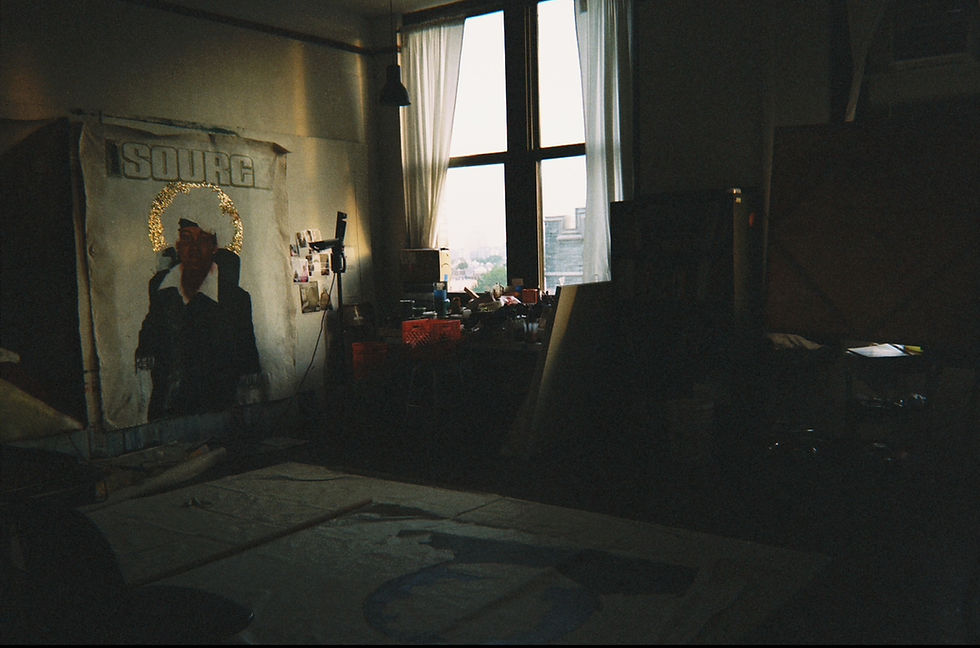
N:The first word that comes to mind is courage: have courage.
People meet the prepared version of me and see the finished work, but they do not see me in the house or studio wrestling with fear. A lot of the time, I am scared because I am about to address something sensitive.
Doing something while you are afraid is courage.
It is not necessarily humility, boldness, or an enormous sense of confidence. It is courage. I had to establish it early in life, and pursuing any dream requires it.
When you are not afraid to feel, to be disliked, or to speak up, those are all expressions of courage. So the thing I would give the next generation is simple: have courage and do it afraid.
Courage.
The final stop on this part of our journey with Nazeer—and, we hope, the next step on yours.
This conversation asks us to look beyond the finished work and toward the life beneath it. To consider how transparency, conviction, faith, and the world around us become part of everything we create. Because art has never been merely decoration. It is one of humanity's oldest languages—a record of who we were, what we believed, and what we chose to leave behind.
We'll leave you with one final question:
What story is your life creating? And when your work outlives you, what will it bear witness to?
Curious about how art can be theraputic? Read about MudNMixtures: An Artist and Therapist, Her Path to Creation, and How She Mentally Sustains.

M: Nah, I’m a self-taught producer. I don’t believe there’s a right or wrong way to make music—everyone has their own thing that works for them. With synthesizers, I got good because I was messing up, playing them the way they weren’t “supposed” to be played, but sonically it stood out. I like throwing weird sounds and instruments together, colliding them all in one—and that’s not something you can really be taught.
M: Nah, I’m a self-taught producer. I don’t believe there’s a right or wrong way to make music—everyone has their own thing that works for them. With synthesizers, I got good because I was messing up, playing them the way they weren’t “supposed” to be played, but sonically it stood out. I like throwing weird sounds and instruments together, colliding them all in one—and that’s not something you can really be taught.
Equal parts intimacy and showmanship—Lucky Daye’s performance feels like R&B remembering what it came here to do.
=